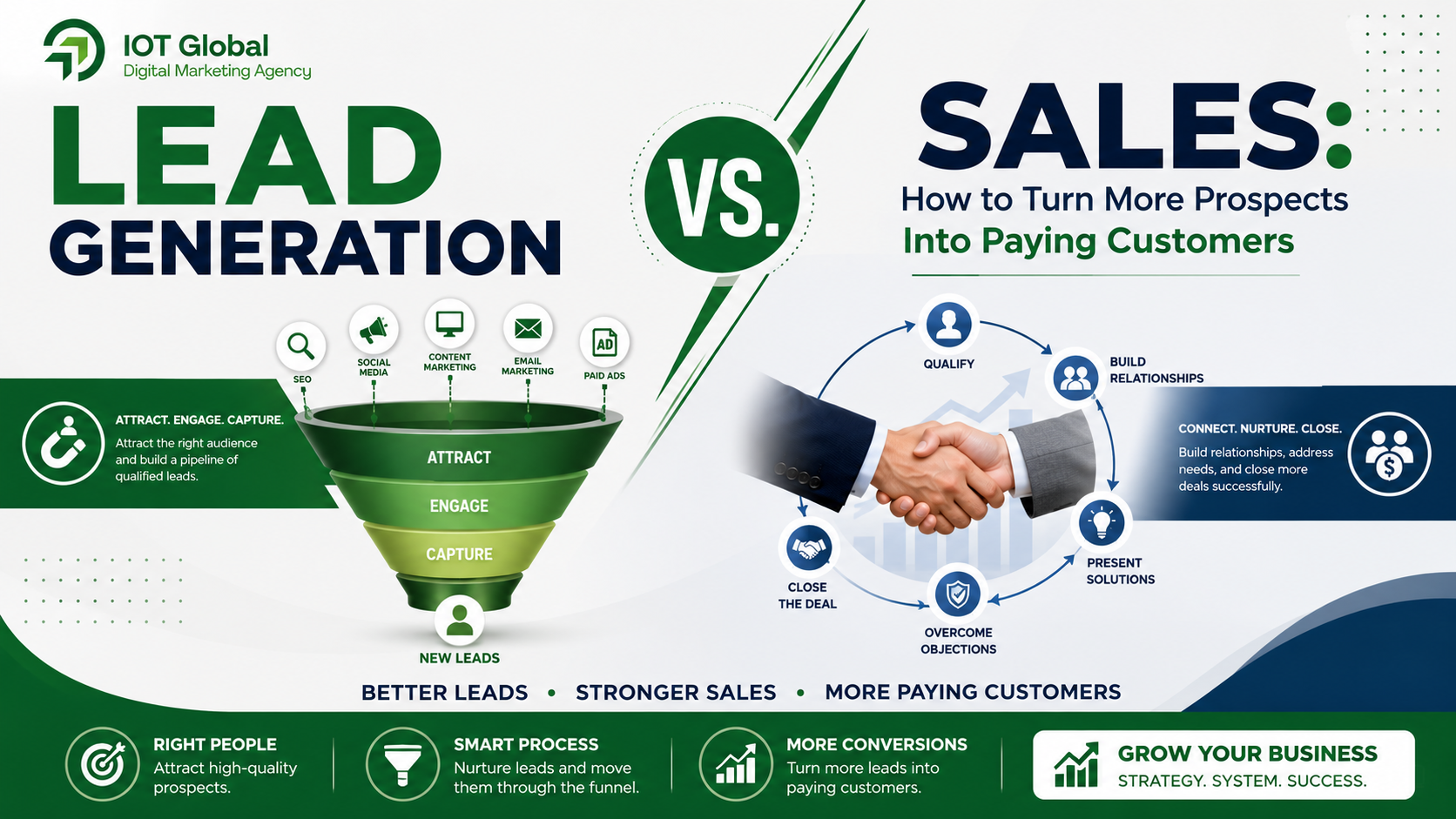
Lead Generation vs. Sales: How to Turn More Prospects Into Paying Customers
Many businesses use lead generation and sales interchangeably, but they are two different parts of the customer journey. Understanding lead generation vs. sales can help your business attract the right prospects, build relationships, and ultimately turn more prospects into paying customers.
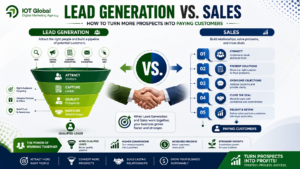
Lead generation focuses on attracting potential customers, while sales focuses on converting those prospects into customers. When these two processes work together, businesses can create a more predictable and effective growth strategy.
What Is Lead Generation?
Lead generation is the process of attracting people who may be interested in your products or services and encouraging them to share their contact information or take another meaningful action.
Businesses can generate leads through several channels, including:
- Search engine optimization (SEO)
- Social media marketing
- Google Ads and paid advertising
- Blog content
- Email marketing
- Landing pages
- Webinars and online events
- Referral marketing
For example, someone searching online for a digital marketing agency may visit your website after finding a helpful blog post. If they fill out your contact form or request a consultation, they become a lead.
The goal of lead generation isn’t simply to get more traffic. It’s to attract qualified prospects who are more likely to become customers.
What Is Sales?
Sales begins after a potential customer shows interest in your business. The sales process involves communicating with the prospect, understanding their needs, explaining your solution, handling objections, and encouraging them to make a purchase.
A typical sales process may include:
- Contacting the lead
- Understanding their needs
- Qualifying the prospect
- Presenting the right solution
- Answering questions and objections
- Following up
- Closing the sale
While lead generation fills your sales pipeline, sales converts qualified opportunities into revenue.
Lead Generation vs. Sales: What’s the Difference?
The simplest way to understand lead generation vs. sales is this:
Lead generation attracts prospects. Sales converts prospects into customers.
Lead generation is primarily focused on awareness, interest, and capturing potential customers. Sales is focused on building trust, demonstrating value, and closing the deal.
For example, a company may generate 100 leads through SEO and advertising. However, if the sales team only converts 10 of those leads, the business has a 10% lead-to-customer conversion rate.
This is why generating more leads isn’t always the answer. Businesses also need an effective sales process.
How to Turn More Prospects Into Paying Customers
Generating leads is only the first step. Here are practical strategies to improve your lead-to-customer conversion rate.
1. Define Your Ideal Customer
Not every lead is a good lead. Clearly define your ideal customer’s industry, needs, budget, challenges, and buying behavior.
When your marketing attracts the right audience, your sales team can spend more time speaking with qualified prospects.
2. Respond to Leads Quickly
Speed matters in sales. When someone requests information, responds to an offer, or submits a contact form, follow up as soon as possible.
A quick response shows professionalism and keeps your business fresh in the prospect’s mind.
3. Build Trust Before Asking for the Sale
Customers don’t simply buy products or services—they buy solutions they trust.
Use testimonials, case studies, reviews, demonstrations, educational content, and clear explanations to reduce uncertainty.
The more confidence a prospect has in your business, the easier it becomes to move them toward a purchase.
4. Understand the Prospect’s Problem
Avoid immediately giving every prospect a sales pitch. First, understand what they actually need.
Ask questions such as:
- What problem are you trying to solve?
- What challenges are you currently experiencing?
- What have you tried before?
- What result are you hoping to achieve?
Once you understand the problem, you can position your product or service as a relevant solution.
5. Create a Strong Follow-Up Process
Many prospects don’t buy immediately. They may need more information, time, or reassurance before making a decision.
Create a structured follow-up process using email, phone calls, or other appropriate communication channels.
The key is to remain helpful rather than overly aggressive.
6. Align Marketing and Sales
Marketing and sales should work toward the same goal.
Marketing should provide sales teams with qualified leads, useful content, customer insights, and clear messaging. Sales teams should provide feedback about lead quality and common customer objections.
This collaboration helps improve both lead generation and sales performance.
Measure the Right Metrics
To improve your results, track the entire customer journey—not just the number of leads.
Important metrics include:
- Number of leads generated
- Cost per lead
- Lead-to-customer conversion rate
- Sales conversion rate
- Customer acquisition cost
- Average deal value
- Return on marketing investment
These numbers can show you where prospects are dropping out of the funnel.
Final Thoughts
Understanding lead generation vs. sales is essential for businesses that want sustainable growth. Lead generation brings potential customers into your marketing funnel, while sales turns qualified prospects into paying customers.
The best results come when both processes work together. Attract the right audience, respond quickly, build trust, understand customer needs, follow up consistently, and continuously measure your results.
Instead of focusing only on generating more leads, focus on generating better leads and converting more of them into loyal customers. That’s how businesses can turn marketing activity into measurable revenue.